

Indigenous women in Canada are at higher risk for adverse pregnancy and infant health outcomes and health disparities are largely attributed to inadequate access to perinatal healthcare. Community-based, Indigenous midwives who provide essential, clinically and culturally supportive healthcare is a sustainable solution. Unlike federal practices that continue to transfer Indigenous women to urban hospitals for delivery at 36-38 weeks’ gestational age, the goal of Indigenous midwifery is to return birth closer to home.
This research aims to examine the costs of obstetric evacuation and the social-cultural benefits of Indigenous midwifery. Through Indigenous midwife and Indigenous community leadership and engagement, this research examined the costs of obstetric evacuation and the social-cultural benefits of Indigenous midwifery. Through interdisciplinary, Indigenous, and mixed methods research, this research compiled information on the costs of obstetric evacuation and perinatal health indicators, as well as supported three case studies, including the Inuit midwifery forum, midwife-patient digital stories and urban birth work support. This information aims to inform best practices on how to support First Nation, Métis and Inuit mothers, infants and communities throughout their pregnancy, birth, postpartum and early months of parenthood.

Research Gaps, Limitations, and Needs

When developing the research questions, methods and approaches, leadership from the National Council of Indigenous Midwives (NCIM), the Native Women’s Association of Canada (NWAC) and Pauktuutit Inuit Women stated that they are regularly asked about economic comparisons and health outcomes information, of which there is none. Therefore, this research project stems from community based and organization information and research needs.
NCIM, NWAC and Pauktuutit also identified the need to include the outcomes and perspectives of Indigenous women within rural, remote and urban settings. And although the FNIHB economic analysis will only include status First Nation and Inuit data, it is recognized that this does not include non-status First Nation and Métis populations, thus demonstrating data gaps and research limitations.
Goals
- Identify economic costs and outcomes of obstetric evacuation and Indigenous midwifery;
- Recognize best practices to support First Nation, Métis and Inuit women throughout their reproductive and perinatal healthcare to address Indigenous maternal-child health disparities;
- Inform perinatal health policy and programming to support Indigenous mothers, families, communities and Nations.
Objectives
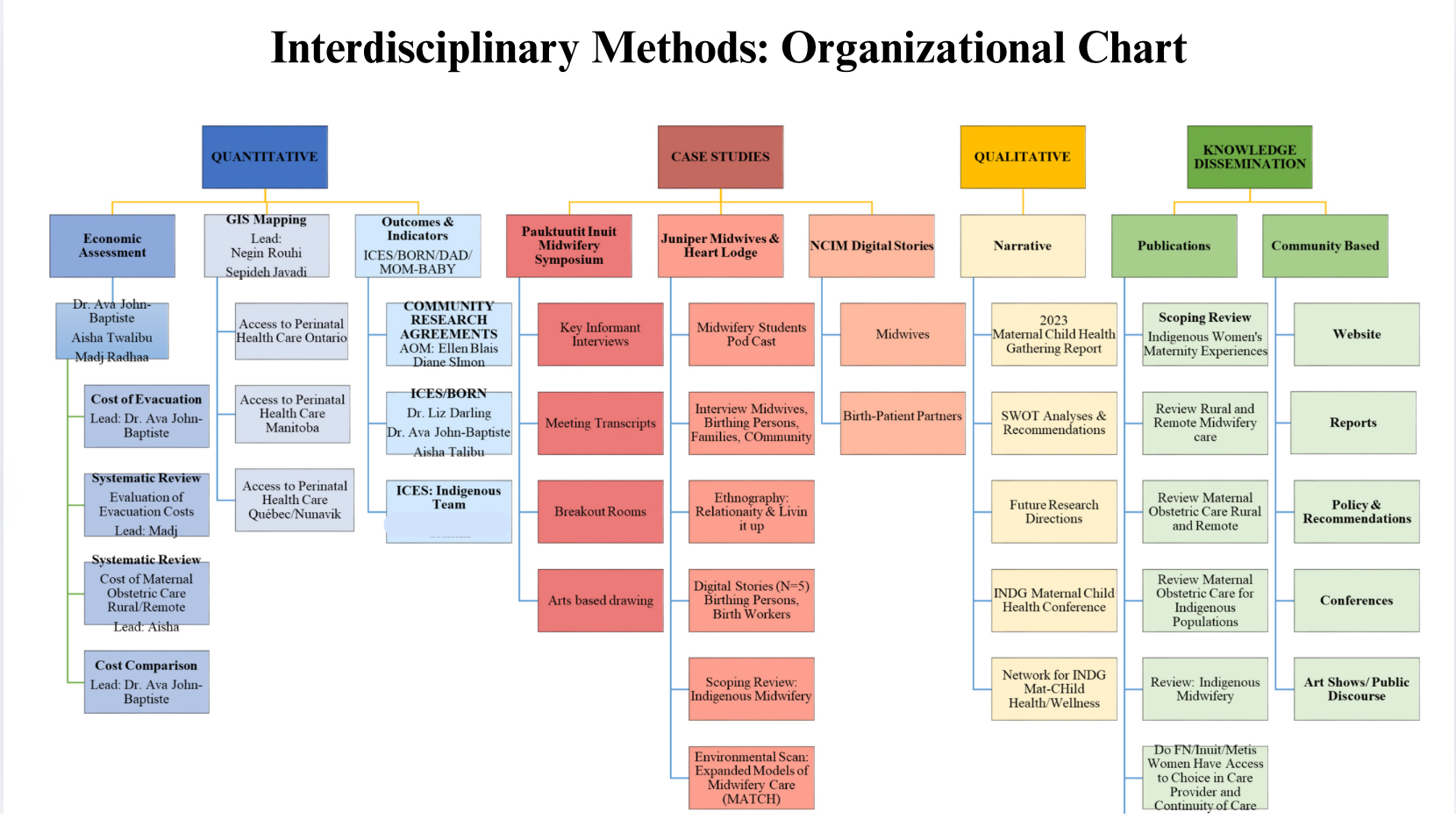
- Research Planning: create an interdisciplinary team that brings together local Indigenous communities and midwives, national Indigenous organizations, federal government departments (policy), Indigenous researchers and academic institutions.
- Conduct an economic analysis of obstetric evacuation and Indigenous midwifery.
- Conduct health-outcomes and indicators analyses.
- Engage Indigenous women, partners, and families. Through community based and decolonized Indigenous research methodologies, the research will engage Indigenous women, partners, and families to share their experiences of Indigenous midwifery through narratives and digital story telling.
Theoretical Lens


We also have this content below:

Historically, research has been conducted “on”, rather than “with” and “by” Indigenous peoples. As a result, the research centers on non-Indigenous perspectives. To address, we are proposing through Integrative Science (Bartlet et. al. 21012) and mixed methods to conduct quantitative and qualitative, interdisciplinary research. The research will draw from Mi’kmaq Elder Albert Marshall’s conceptualization of Etuaptmumk, or ‘Two-Eyed Seeing.’ Two-eyed seeing is the ability to “see from one eye with the strengths of Indigenous knowledge and ways of knowing and from the other eye with the strengths of Western knowledge and ways of knowing … and learning to use both these eyes together, for the benefit of all” (CIHR, 2013). The theoretical lens below: “Gwayakgooshgawin” (Leason 2017) translates to balance and aims to bring together the following four disciplines:
- Population & Public Health: economic analysis of obstetric evacuation and midwifery programs.
- Indigenous Theory & Methods: epistemology, axiology, ontology and methodologies: decolonizing.
- Critical Medical Anthropology: critically examine medicalization of birth and medical institutions.
- Gender Studies & Indigenous Feminism: critically examines racism, sexism and colonialism and the need to resurge/reclaim Indigenous midwifery.
Methods
Stories From Researchers
Dr. Jennifer Leason
Midwifery Methods Overview
Dr. Liz Darling
Perinatal Health Data
Majd Radhaa
Systematic Review
Majd Radhaa
Data Injustice and Connection
Our theory of Transformation
1.
Gather as an interdiscplinary team through lens of Gwayakooshgawiin, Two-Eyed Seeing & the 7 Grandfather teachings
2.
Measure costs and outcomes of each approach
3.
Evidence is generated in the form of data sets, data analysis, recommendation, policy briefs that quantify the costs and assess the health outcomes of each approach
4.
Evidence-informed policies and programs are developed to inform budget allocations
5.
Investments in sustainable, safe care that is close to home and family rooted in continuity and cnonection